
Rakour
Menu
LiFePO4 Solar Battery Storage for Home — Clean Power Day & Night

Home Energy Storage Solutions

LiFePO4 Solar Battery Storage for Home — Clean Power Day & Night

Store solar energy with LiFePO4 batteries rated for 6,000+ cycles. Cut electricity bills, stay powered during outages, and maximize self-consumption.

What Is a Home Solar Battery Storage System

How It Works, What It Includes, and Which Setup Fits Your Home

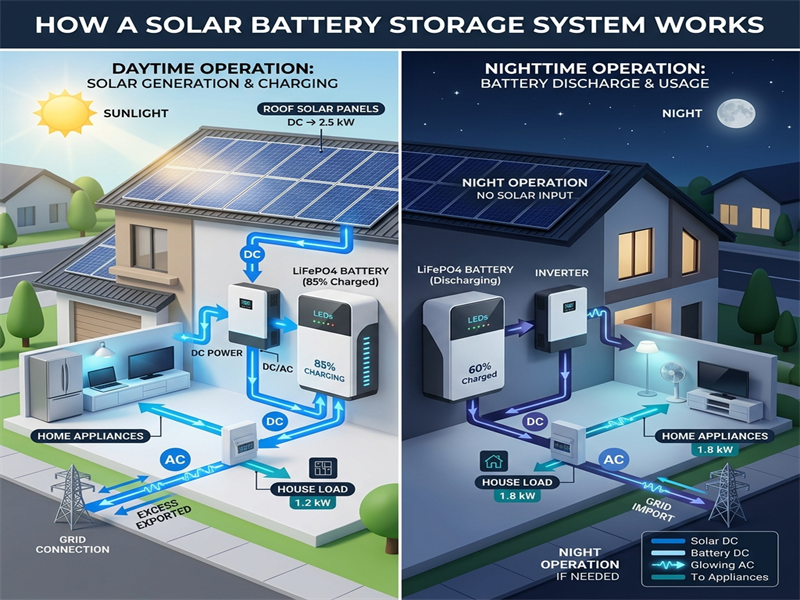
Solar battery storage system diagram showing electricity captured from solar panels, stored in LiFePO4 modules, and converted to AC for household appliances.

How the Solar Battery Storage System Works

RAKOUR's solar battery storage system captures excess electricity from solar panels during daylight and stores it in LiFePO4 battery units. A built-in inverter automatically converts DC to AC, delivering usable power directly to home circuits. When solar production drops — at night or on cloudy days — the system instantly draws from stored reserves.
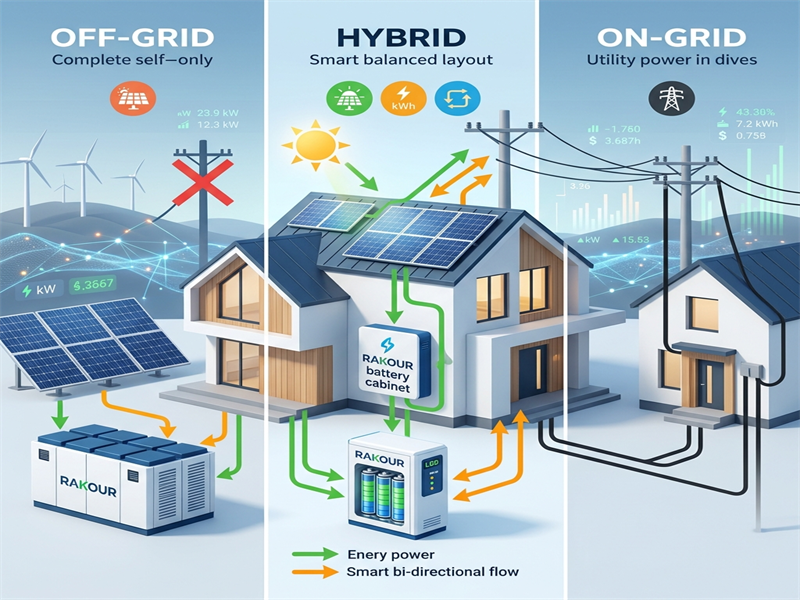
Comparison diagram of home battery backup deployment modes: On-Grid, Off-Grid, and Hybrid configurations, highlighting hybrid operation.

Three Deployment Modes: On-Grid, Off-Grid, and Hybrid

RAKOUR systems support on-grid, off-grid, and hybrid configurations. Hybrid mode is the most practical for residential use: it stays grid-connected for reliability while the battery handles peak loads, outages, and overnight consumption. This eliminates the need to choose between grid dependence and costly full off-grid investment.

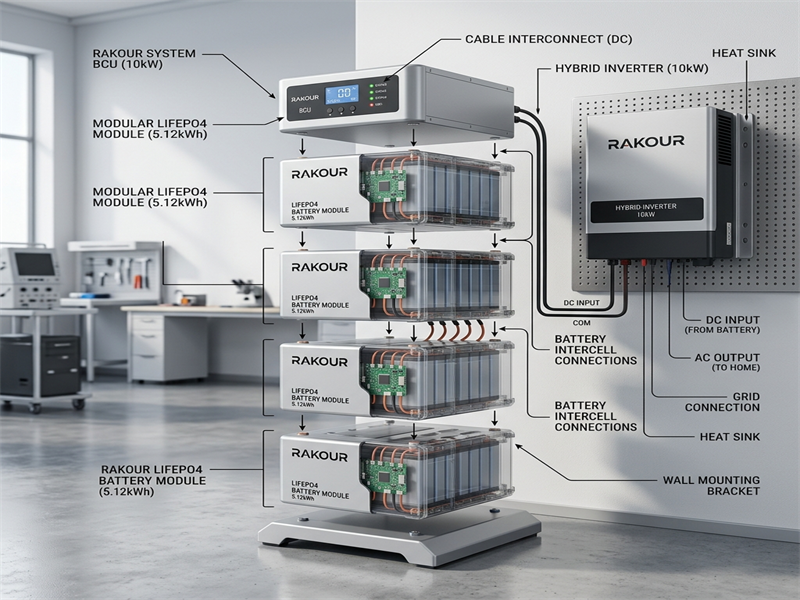
Exploded view of a modular residential battery storage system, showing LiFePO4 modules, Battery Control Unit (BCU), and external hybrid inverter.

What Makes Up a Residential Battery Storage System

A complete residential battery storage system includes LiFePO4 modules, a BCU (Battery Control Unit), and a compatible inverter. RAKOUR's LV and HV lines cover 5.12 kWh to 160+ kWh, with up to 15 units in parallel. This modular design lets every household start at the right capacity and expand as needs grow.

Learn More Residential Solutions

From modular low-voltage racks to high-capacity cabinets, RAKOUR adapts seamlessly to your home's growing power demands. Connect with our experts to find the right capacity and start your journey toward complete energy independence.

Explore More

Core Benefits for Homeowners

How RAKOUR Delivers Backup Power, Lower Bills, and Long-Term Energy Value

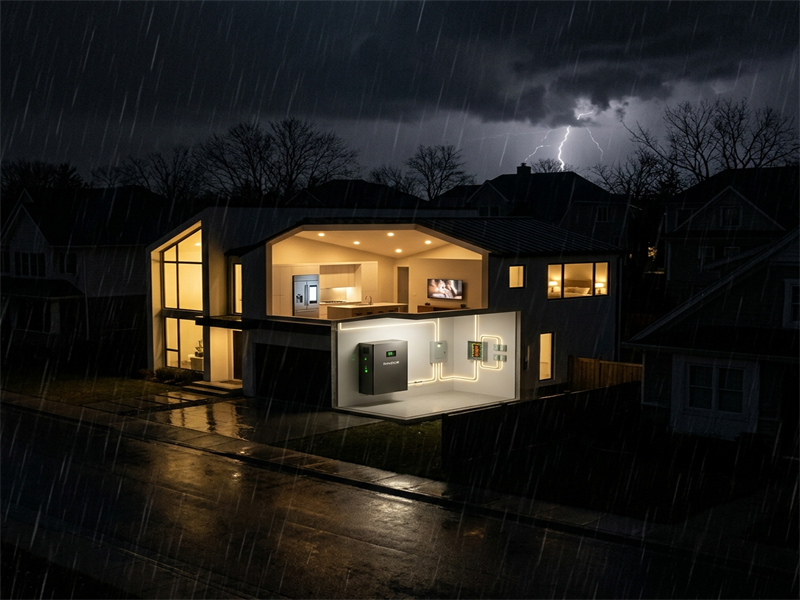
A residential house powered by RAKOUR home battery backup system during a night storm and grid outage, showing lights and appliances running seamlessly.

Reliable Backup Power During Grid Outages

RAKOUR batteries keep refrigerators, lighting, routers, and HVAC running during grid outages. With up to 15 units in parallel, runtime can exceed 24 hours on a full charge. The system switches to backup mode in under 10ms — fast enough that most appliances and sensitive electronics never register an interruption at all.

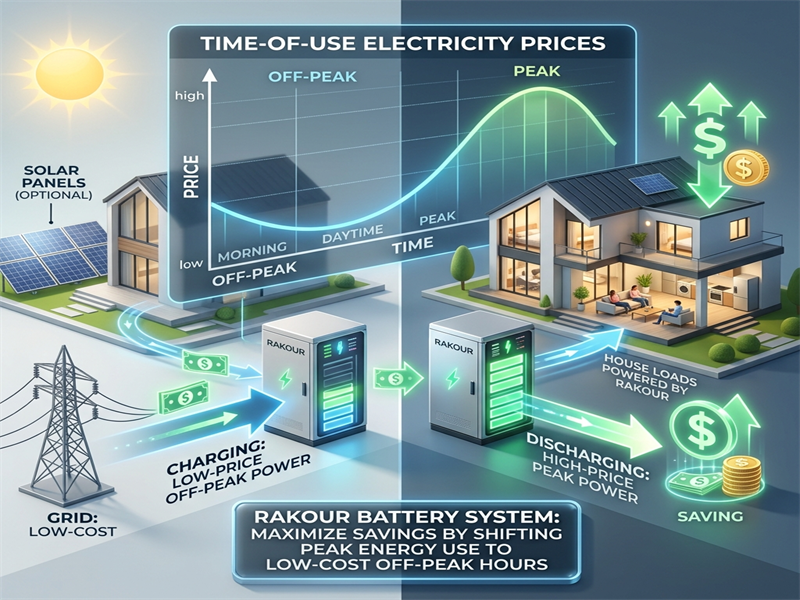
Home energy storage system infographic illustrating peak shaving and cost reduction by charging during off-peak times and discharging during peak-rate evening hours.

Cut Electricity Bills with Home Energy Storage

Time-of-use pricing charges significantly more during evening peak hours. RAKOUR's home energy storage system stores surplus solar energy generated midday and discharges it after sunset, bypassing the most expensive grid windows. Households with properly sized solar-plus-storage setups typically reduce grid electricity purchases by 60–80%.

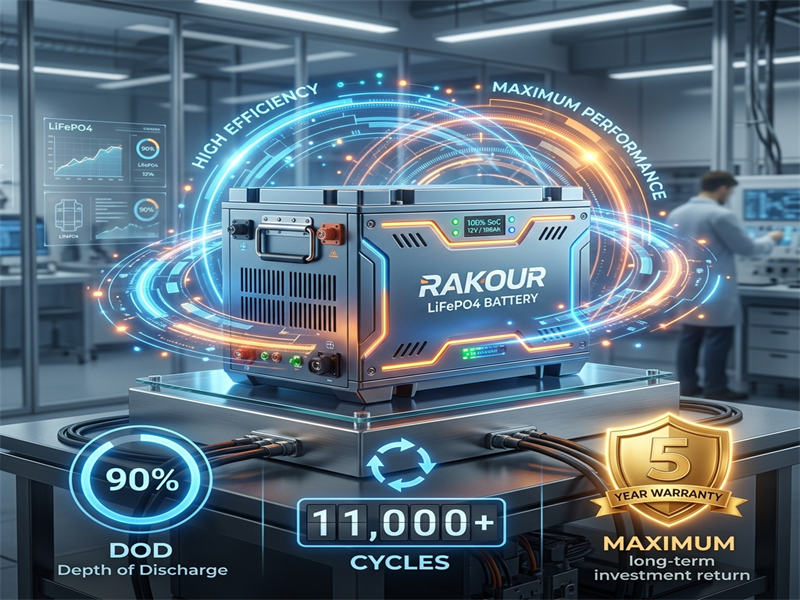
High-performance RAKOUR LiFePO4 battery module showing long life statistics including 11,000 cycles, 90% DOD, and a 5-year warranty.

Maximize Return on Investment Over System Lifetime

RAKOUR modules operate at 90% depth of discharge (DOD), making nearly all stored capacity usable. With a cycle life of 6,000–11,000 cycles depending on the model, and a 5-year manufacturer warranty, RAKOUR systems deliver measurable, long-term returns without sacrificing day-to-day reliability or performance across years of daily cycling.

Battery Technology Deep Dive: LiFePO4 vs Other Chemistries

Why Lithium Iron Phosphate Is the Right Choice for Residential Solar Storage

Why RAKOUR Chooses Lithium Iron Phosphate Chemistry

RAKOUR uses lithium iron phosphate (LiFePO4) chemistry across its entire residential lineup. Unlike NMC, LiFePO4 carries no thermal runaway risk under normal conditions, remains stable between -20°C and 60°C, and retains over 80% capacity after thousands of full charge-discharge cycles — a critical advantage for daily residential use.

LiFePO4 vs Lithium Ion NMC: A Direct Comparison

In a LiFePO4 vs lithium ion NMC comparison, LiFePO4 wins on safety, cycle life, and temperature tolerance. NMC offers marginally higher energy density but degrades faster and poses greater thermal risk under stress. For residential daily cycling, LiFePO4 consistently delivers a lower cost-per-cycle across the full system lifespan.

Certifications That Prove What the Specs Claim

RAKOUR's LiFePO4 cells are certified under IEC 62619, CE, ROHS, UN38.3, and MSDS. Every module undergoes factory-level cell grading and full capacity verification before shipment. These certifications are not optional extras — they are baseline engineering requirements built into every RAKOUR battery unit from the design stage forward.

How to Size a System for Your Home

Matching RAKOUR Home Solar Battery Systems to Your Actual Energy Needs

Step One: Calculate Your Daily Energy Consumption

Start by reviewing your monthly electricity bill for average daily kWh consumption. A typical home using 30 kWh/day needs roughly 10–16 kWh of usable battery capacity to cover evening and overnight loads. RAKOUR's LV rackable series starts at 5.12 kWh and scales to 80+ kWh through parallel expansion — no full replacement required.

Choosing the Right RAKOUR Product Line

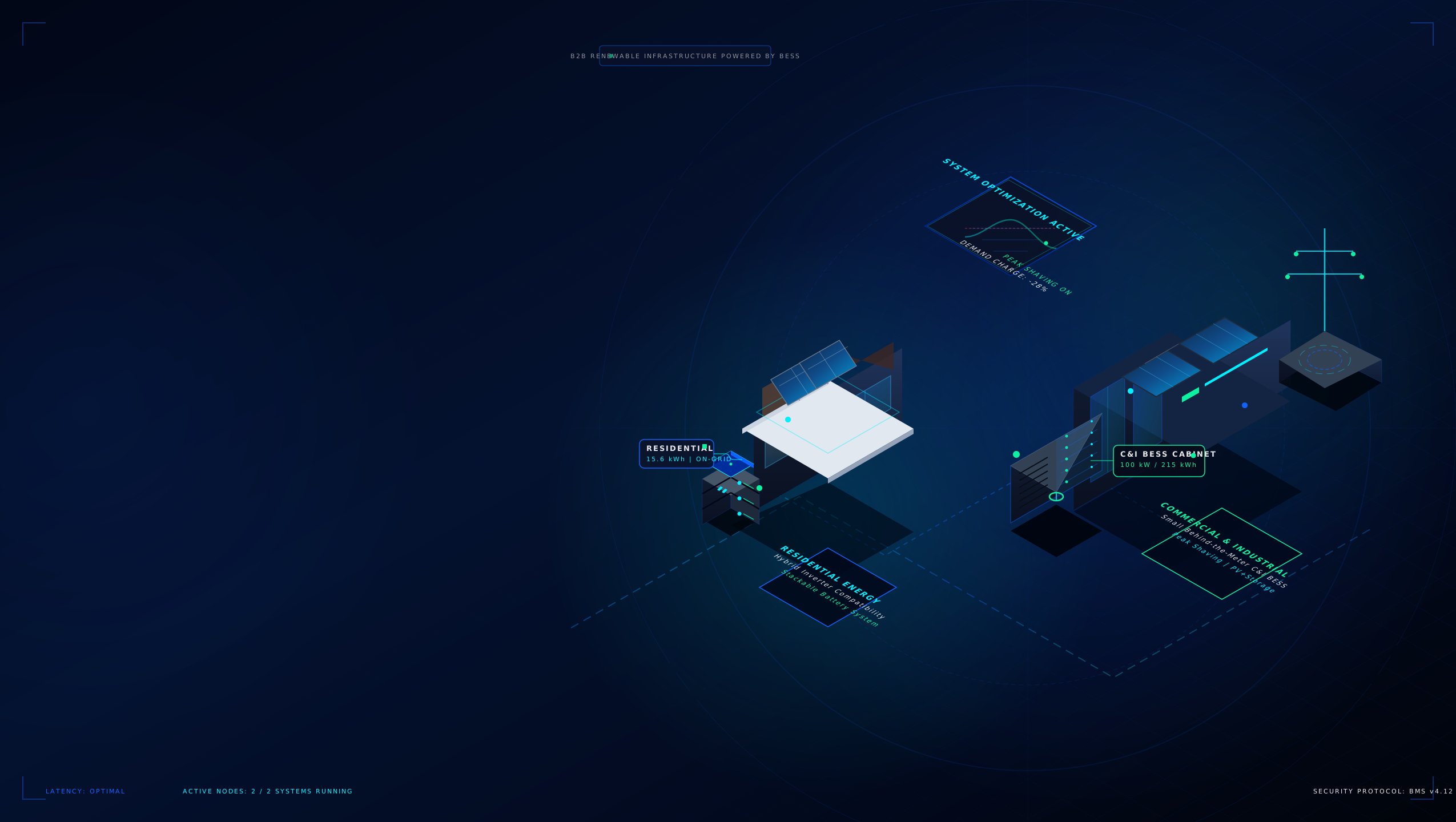
RAKOUR offers three product families for home solar battery systems: the LV Rackable series (5.12–16 kWh), the wall and ground-mount NSTLV series (10.2–16 kWh), and the HV Rackable series reaching 160+ kWh. Each is designed for specific inverter voltage ranges, installation environments, and load profiles.

Safety Standards & Certifications

The Protection Architecture That Makes RAKOUR Batteries Safe for Daily Home Use

How the Battery Management System Protects Your Home

RAKOUR's battery management system (BMS) monitors cell voltage, current, and temperature in real time across every module. It enforces protections against overcharge, over-discharge, overcurrent, and high/low temperature faults. When any parameter exceeds safe limits, the BMS instantly disconnects the circuit — protecting the battery and all connected appliances from damage.

Third-Party Certifications Behind Every RAKOUR Unit

Every RAKOUR LiFePO4 unit is certified under IEC 62619, CE, ROHS, UN38.3, and MSDS standards. The HV series BCU adds active fan cooling and a built-in soft-start circuit that protects inverters without native soft-start support. An IP20 enclosure rating guards internal components against dust and accidental contact.

Dual-Layer BMS Architecture in Multi-Module Systems

RAKOUR's dual-layer BMS architecture separates the master BMS in the BCU from slave BMS boards embedded in each module. The master BMS collects cell-level data via internal CAN bus and issues coordinated charge/discharge commands. This two-tier design prevents single-point failure and keeps multi-module parallel systems balanced automatically without any manual intervention.

Compatibility & Integration

How RAKOUR Solar Battery Systems Connect to Your Inverter and Existing Setup

Inverter Communication: CAN, RS485, and RS232

RAKOUR batteries communicate over CAN, RS485, and RS232 protocols, covering the interface requirements of major inverter brands worldwide. The BMS actively negotiates charging voltage and current with the inverter in real time, eliminating manual parameter setup and significantly reducing configuration errors during installation.

AC-Coupled vs DC-Coupled: Which Integration Fits Your Project

The solar battery system supports both AC-coupled and DC-coupled configurations. AC coupling lets RAKOUR batteries integrate with an existing solar installation without replacing the current inverter. DC coupling, preferred for new builds, routes solar power directly through the battery for higher round-trip efficiency and lower conversion losses overall.

Parallel Expansion and System Capacity Ceilings

RAKOUR's LV series supports up to 15 units in parallel; the HV series supports up to 4 cabinet sets, reaching 160+ kWh total system capacity. Inter-unit communication runs via RS485-2, with one CAN port connecting the host battery to the inverter — keeping wiring clean and the overall installation straightforward for certified solar professionals.

Total Cost of Ownership & ROI Analysis

Understanding the Real Financial Return of a RAKOUR Home Storage Investment

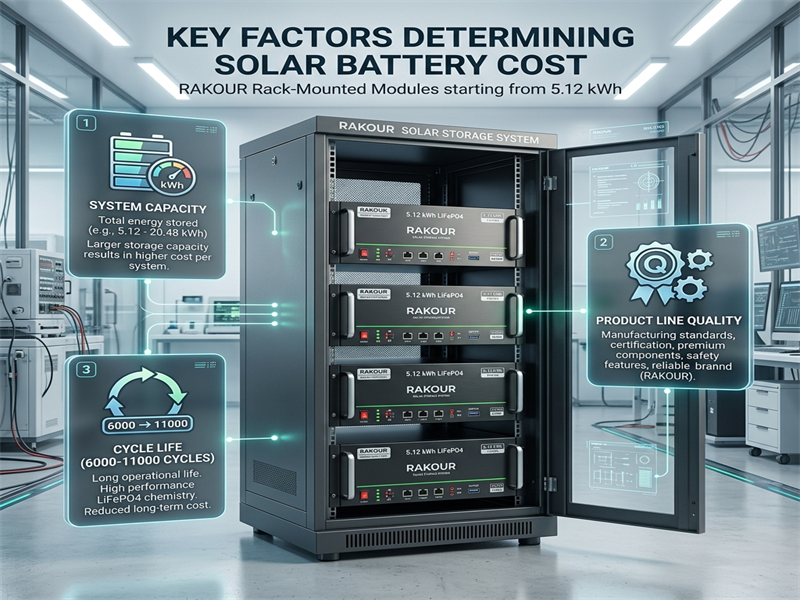
Sleek RAKOUR rack-mounted battery modules inside a cabinet, illustrating residential solar battery cost factors like capacity and cycle life.

What Determines Solar Battery Cost for Residential Systems

Solar battery cost depends on system capacity, product line, and installation complexity. RAKOUR's LV rackable units start at 5.12 kWh, giving homeowners a lower entry point before scaling up. High cycle life — 6,000 to 11,000 cycles depending on model — means cost-per-cycle drops significantly compared to shorter-lived alternatives.

RAKOUR battery cabinet displaying global certification badges like CE and IEC 62619, highlighting local incentive qualification.

Incentives That Reduce Solar Battery Backup Cost

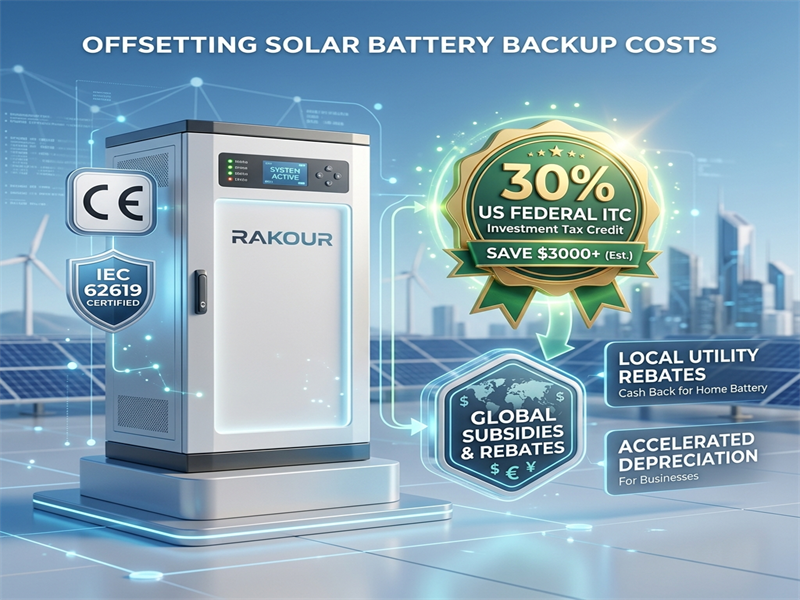
Solar battery backup cost is offset by incentives in many markets. The U.S. federal ITC covers 30% of qualifying storage installations. European and Australian programs offer additional rebates. RAKOUR's CE and IEC 62619 certifications ensure the system qualifies for incentive programs in most regulated markets globally.

Timeline graph showing residential battery storage payback period between 6 to 9 years followed by lifetime energy savings.

Calculating Your Payback Period and Long-Term Savings

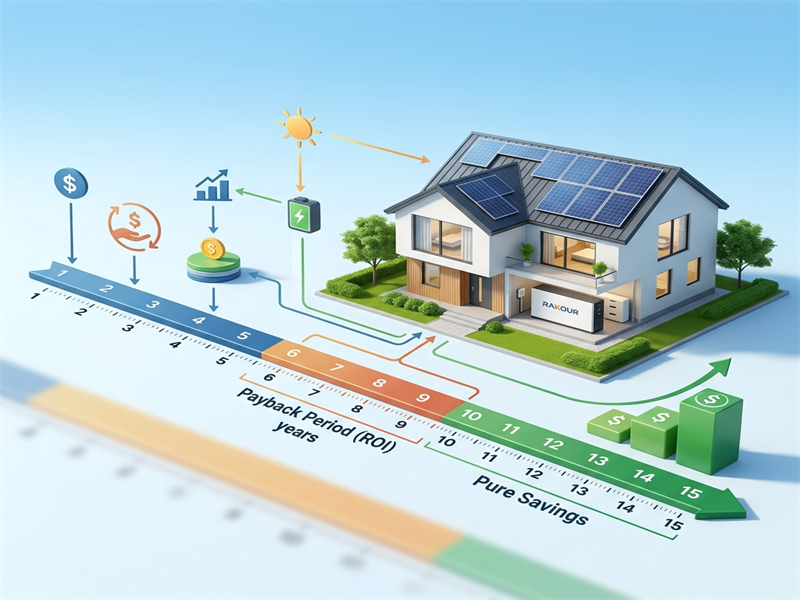
A RAKOUR system storing 10–16 kWh and cycling daily can offset 60–80% of grid electricity purchases. At average residential electricity rates, most installations recover net cost within 6–9 years — well within the battery's rated service life. After payback, every additional year of operation delivers pure energy savings for the household.

Warranty, Lifespan & After-Sales Support

What RAKOUR's Battery Warranty and Service Commitments Actually Mean for You

What the 5-Year Battery Warranty Covers

Every RAKOUR battery carries a 5-year manufacturer battery warranty covering defects in materials and workmanship. HV series flagship products offer an extended 5+5 year structure. RAKOUR commits to maintaining ≥80% rated capacity throughout the full warranty period — a quantified, verifiable promise, not a vague assurance buried in fine print.

Cycle Life Ratings Grounded in Tested Cell Data

Cycle life ratings reflect factory-tested cell performance under real conditions. The 51.2V280Ah-LV is rated for ≥10,000 cycles; the 314Ah models reach ≥11,000 cycles. At one full cycle per day, that equates to 27–30 years of projected service before capacity falls below 80% — far exceeding the warranty period itself.

Remote Monitoring and Authorized Dealer Support

RAKOUR's built-in WiFi module and touch-screen interface allow owners and installers to monitor SOC, cell voltage, temperature, and fault history remotely via smartphone. When issues arise, diagnostic data is exportable via the RS232 port, helping service teams resolve problems efficiently. Authorized dealers handle local warranty fulfilment in each sales region.

Frequently Asked Questions

Get clear answers to the most common questions about home solar battery storage systems and RAKOUR.

How does a battery management system protect my home during a power outage?

RAKOUR's BMS monitors voltage, current, and temperature in real time. When the grid fails, it switches to backup in under 10ms — keeping appliances running without any noticeable interruption.

What is the difference between solar battery cost and total cost of ownership?

Solar battery cost covers equipment and installation. RAKOUR's 6,000–11,000-cycle LiFePO4 chemistry lowers cost-per-cycle over time, making total ownership cost one of the lowest available.

Can a solar battery system work with my existing inverter brand?

Yes. RAKOUR supports CAN, RS485, and RS232 protocols, compatible with most major inverter brands. The BMS auto-negotiates charge parameters — no manual inverter reconfiguration is typically needed.

How long does a LiFePO4 battery last compared to other lithium ion chemistries?

RAKOUR LiFePO4 batteries are rated 6,000–11,000 cycles — roughly 16–30 years at daily cycling. NMC lithium ion typically lasts 1,500–3,000 cycles and carries higher thermal risk under daily stress.

What does the battery warranty cover and how do I make a claim?

RAKOUR's 5-year warranty covers defects and guarantees ≥80% capacity retention. The HV series offers 5+5 years. Claims go through authorized dealers, with remote diagnostics via WiFi and RS232.

Get Your Custom RAKOUR Storage Solution

Get Your Custom RAKOUR Storage Solution

Tell us your energy needs — our team will design a RAKOUR system sized perfectly for your home.