

Rakour
Menu
Complete Off Grid Solar System for Home: LFP Microgrid & Energy Storage Solutions

Home Microgrid & Off-Grid Power Solutions

Complete Off Grid Solar System for Home: LFP Microgrid & Energy Storage Solutions

Power your home independently with Rakour's scalable LFP battery systems. Seamless islanding, smart BMS protection, and up to 15-unit parallel expansion — built for true energy independence.

What Is a Home Microgrid & Off-Grid Solar System?

Understand the core difference between off-grid and microgrid setups — and why it shapes every component in your Rakour energy system.

What Is an Off-Grid Solar System

An off grid solar system combines solar panels, a battery bank, and an inverter to power your home without any utility connection. Unlike grid-tied setups, all generated energy is stored locally in LFP batteries, supplying your home around the clock — day, night, or during grid failures — with zero dependency on the utility provider.
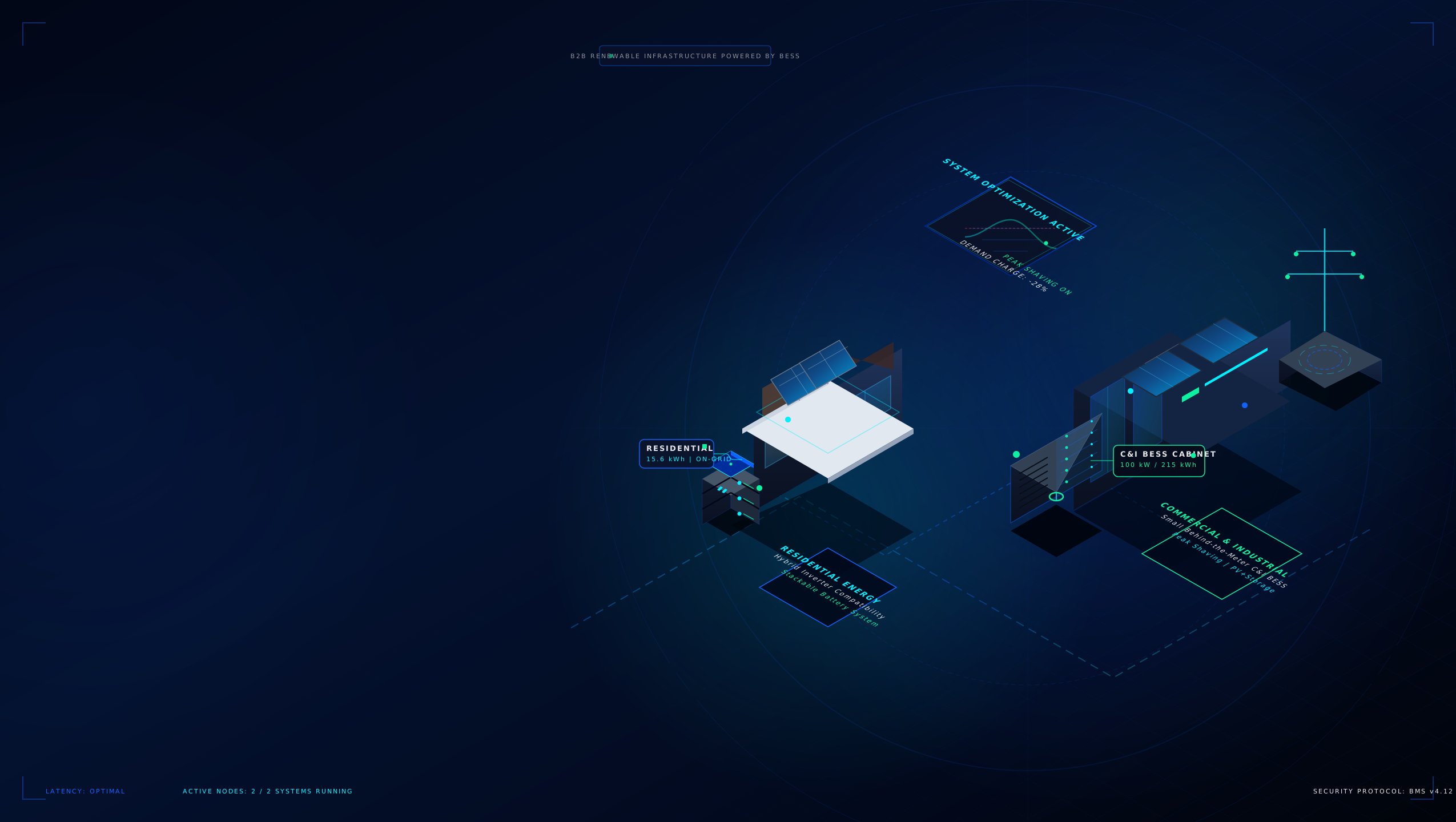
Microgrid vs. Off-Grid: Key Differences

A microgrid adds intelligent control on top: it can operate grid-connected or fully islanded. Microgrids and energy storage work together so power flow, battery dispatch, and load balancing are managed automatically. Rakour's LV and HV series support both modes, giving homeowners a future-proof, scalable path to energy independence without any manual switching required.

How Rakour's Off-Grid Solar System Works: Architecture & Energy Flow

From solar panels to household loads, every watt is intelligently managed — here's how Rakour moves and stores your energy.

Energy Flow: Solar Panels to Home Loads

Solar panels charge Rakour's battery energy storage system during daylight hours. The built-in BMS monitors voltage, current, and temperature, optimizing each cycle. When solar output drops — at night or on cloudy days — stored energy discharges automatically to all household loads, delivering seamless, uninterrupted power with no manual intervention required.

Island Mode & Seamless Grid Switching

When grid anomalies occur, Rakour switches to island mode in under 10 ms, protecting appliances from surges. Off grid solar electricity dispatch is managed by the BCU, which coordinates multiple modules, balances charge across units, and restores grid-tied operation automatically once conditions normalize — zero user action needed.

Why Choose Rakour for Home Battery Backup & Off-Grid Power?

Beyond basic backup — Rakour delivers climate-proof resilience, a 15+ year LFP lifespan, and freedom from rising utility rates.

Energy Independence — With or Without the Grid

Grid outages and rising costs no longer dictate your day. Rakour also supports home battery backup without solar — batteries charge via generator or off-peak grid power, then discharge when needed. Operating from −20 °C to 60 °C, the system stays reliable in desert heat and mountain winters alike, ensuring year-round performance in any climate zone.

LFP Chemistry: 6,000+ Cycles, Zero Thermal Runaway

Rakour uses LFP cells rated for ≥ 6,000 cycles — over 15 years of daily use. LFP eliminates thermal runaway risk found in standard lithium-ion batteries. Multi-layer BMS protection guards against overcharge, over-discharge, and overcurrent. Batteries retain above 80 % capacity at end-of-life, delivering the lowest long-term cost-per-kWh stored.

Rakour Product Matrix: Residential Energy Storage for Every Home

From compact off-grid cabins to large family homes — compare LV and HV series to match your load profile and expansion plans.

Low Voltage Series: 5.12–16 kWh, Up to 15 Units Parallel

For homeowners evaluating residential energy storage, Rakour's LV series — 5.12 kWh to 16 kWh per unit — supports up to 15 parallel units, reaching 240 kWh total usable capacity. Compatible with major low-voltage inverter brands, the LV series suits compact installations and retrofit projects where existing wiring must be preserved without costly rewiring.

High Voltage Series: Best Off-Grid Solar System for High-Demand Homes

Choosing what are the best off grid solar systems for larger loads? Rakour's HV series connects 5–17 modules in series from 232 V to 979 V, handling EV charging and future expansion. Deye-compatible configurations are factory-tested and ship with full commissioning documentation for professional installation.

How to Size Your Off-Grid Solar System: Capacity Planning Guide

Avoid under-sizing or over-spending — use Rakour's sizing framework to match battery capacity to your real daily load.

Calculate Your Daily Load Before Buying

Start with total daily consumption in kWh, then factor in backup days and depth of discharge (DoD). Example: 15 kWh/day × 2 backup days ÷ 0.9 DoD = ~33 kWh required. Rakour's off grid solar system packages with batteries include LV units from 5.12 kWh, stackable to 240 kWh — covering essential loads to whole-home operation.

Appliance Start Currents & Future Expansion

HVAC, water pumps, and refrigerators draw 3–7× rated power at startup. Rakour's HV series includes a soft-start circuit that absorbs these surges without tripping. Always size 15–20 % above your calculated need for future appliances. Rakour's modular design lets you add battery units later — no full system replacement needed at any stage.

Smart BMS: How Rakour's Battery Management System Protects Your Investment

Every Rakour battery ships with a multi-layer BMS architecture — here's what it monitors, what it blocks, and why it matters for longevity.

Real-Time Cell Monitoring Across Every Module

Rakour's battery management system tracks cell voltage, pack current, and temperature across every module simultaneously. The master BMS in the BCU communicates with slave BMS units via CAN bus. Any out-of-range parameter triggers instant protective isolation of the affected cell — without interrupting power supply to the rest of your home.

Six Protection Layers & Automatic Fault Recovery

The BMS battery management stack enforces overcharge, over-discharge, overcurrent, short circuit, and high/low temperature cutoffs. Once a fault clears, the BMS auto-recovers without manual reset. Built-in WiFi enables smartphone monitoring of SOC, cycle count, and live alerts — giving owners full visibility into system health at any time.

Safety Standards & International Certifications Behind Every Rakour Battery

Certifications are engineering proof — Rakour batteries perform safely under real-world stress, including outages, surges, and extreme temperatures.

LFP Chemistry: Intrinsically Safer Than NMC or LCO

Lithium iron phosphate is structurally stable at high temperatures, making thermal runaway virtually impossible. For reliable power outage battery backup, this matters: during grid failure, batteries discharge for hours. Rakour LFP cells operate from −20 °C to 60 °C — no venting, no combustion risk under sustained heavy load.

IEC, CE & UN38.3 Compliance — Plus Storage Safety Rules

Rakour batteries meet IEC, CE, and UN38.3 transport standards. For long-term storage, keep SOC between 30 %–60 % and recharge within 15 days when stored below 25 °C. These parameters are factory-programmed into the BMS and cannot be overridden — ensuring full warranty coverage and maximum cycle life across the battery's entire service period.

Inverter Compatibility & Installation Ecosystem for Rakour Systems

A complete off-grid setup needs more than batteries — Rakour integrates with leading inverters and offers three mounting formats for any site environment.

Compatible Inverters & Solar Battery Storage System Configurations

Rakour's solar battery storage system supports CAN, RS485, and RS232 communication protocols, enabling compatibility with Deye and other major inverter brands. The on-unit touch screen allows protocol switching on-site without rewiring. LV series pairs with low-voltage inverters; HV series handles high-voltage hybrid inverters up to 980 V DC input voltage.

Three Mounting Options for Any Off-Grid Inverter Installation Site

Rakour supports rack-mounted, wall-mounted, and ground-wheel configurations for any site layout. Every off grid inverter-compatible package ships with wiring diagrams, commissioning guides, and BMS firmware documentation — reducing on-site installation time and enabling faster, error-free project commissioning for professional integrators on any residential or light-commercial site.

Frequently Asked Questions

Find clear answers to the most common questions about Rakour off-grid systems and battery storage.

What size battery energy storage system do I need for a fully off-grid home?

Multiply daily kWh usage by backup days, then divide by DoD (0.9 for LFP). A 3-person home using 15 kWh/day with 2 backup days needs ~33 kWh. Rakour's LV series scales from 5.12 kWh to 240 kWh.

Can Rakour work as a home battery backup without solar panels installed?

Yes. Rakour batteries charge from grid off-peak or via generator, then discharge during outages. BMS protections and auto-recovery work identically regardless of charge source — solar, grid, or gen.

How does the battery management system protect against overcharge and thermal faults?

Rakour BMS monitors cells via CAN bus, enforcing overcharge, over-discharge, overcurrent, and temperature limits. Faults isolate in milliseconds. Recovery is fully automatic once conditions clear.

Which off-grid inverter brands are compatible with Rakour battery systems?

Rakour supports CAN, RS485, and RS232, compatible with Deye and major inverter brands. Switch protocol via on-unit touch screen — no rewiring. Both series ship factory-tested with commissioning docs.

What certifications do Rakour batteries hold for residential energy storage use?

Rakour meets IEC, CE, and UN38.3 standards. LFP eliminates thermal runaway risk. BMS settings are factory-locked. Full safety datasheets cover local permitting and grid interconnection requirements.

Ready to Power Your Home Off the Grid?

Ready to Power Your Home Off the Grid?

Tell us your load profile — our engineers will size the right Rakour system within 24 hours.