
Rakour
Menu
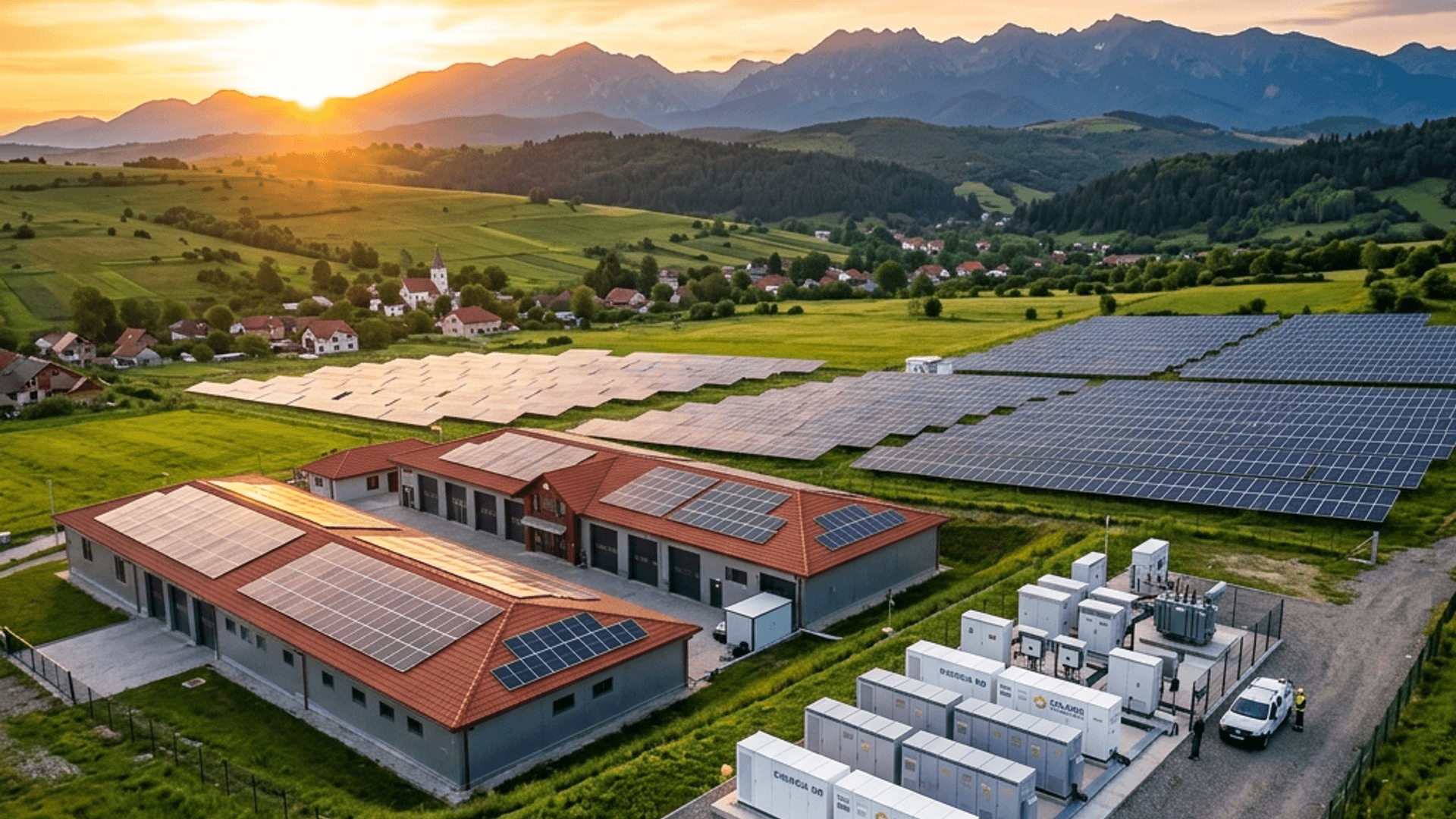
Commercial facility with solar panels on red tiled roofs and battery storage cabinets in Romania at sunrise.

Romania Energy Regulation Update

Romania Prosumer Storage Mandate: What You Need to Know Before the 2027 Deadline

Understand Law 255/2024 capacity thresholds, storage sizing rules, compliance deadlines, and export penalties so your PV system stays connected and fully compliant.

What Is the Romania Prosumer Storage Mandate?

Romania's grid-stability law now ties every prosumer's solar export rights to battery storage capacity.


Why Romania Introduced Mandatory Solar Battery Storage

Romania's transmission grid has struggled with midday solar oversupply as rooftop PV additions outpaced utility-scale generation across the entire country. Regulators concluded that uncontrolled export from prosumers was driving grid congestion and localized blackouts in several distribution regions during peak sunlight hours each summer season.
 

Law 255/2024 at a Glance

The Romania Prosumer Storage Mandate answers this bottleneck directly, requiring battery storage rather than unlimited grid injection from rooftop solar systems nationwide. Adopted by Parliament, Law 255/2024 forms the legal backbone behind the Romania Prosumer Storage Mandate for every affected household and commercial business owner alike.


What the Mandate Means for Rooftop PV Owners

RAKOUR's LiFePO4 systems were engineered for exactly this shift, pairing solar production with dispatchable storage instead of relying solely on the national network for balance and long-term stability. RAKOURHV and RAKOURLV ranges are built to match these compliance requirements from the very first day of installation onward, without redesign.

Legal Basis and Official Regulatory Framework

The mandate rests on specific statutes and ANRE technical rules, not informal guidance.


Law 255/2024 and Its Statutory Scope

Romania's storage obligation is not a general policy guideline; it is embedded directly in binding national legislation. Law 255/2024, adopted by Romania's Chamber of Deputies, amends the national electricity framework to require battery storage alongside new and existing rooftop solar capacity nationwide, effective immediately for qualifying systems.


Supporting Statutes Behind the Framework

Law 255/2024 works alongside Law 123/2012, which governs generation, storage, and distribution licensing across the entire sector, and GEO 163/2022, which first defined prosumer rights to store and resell electricity to suppliers or direct-line consumers under earlier reform packages passed since 2022.


ANRE's Technical Enforcement and RAKOUR's Compliance Documentation

Technical enforcement sits with ANRE, Romania's energy regulator, which issues the metering and connection rules translating statute into daily practice for installers. ANRE storage compliance covers how capacity is verified at grid connection, and RAKOUR documents certified capacity and cycle data so installers demonstrate ANRE storage compliance without added paperwork or delay.

Who Is Affected: Capacity Thresholds Explained

Thresholds differ for new and existing systems, and the gap changes who must comply.


New Installations: The 10.8 kW–400 kW Threshold

Not every rooftop system falls under the same rule, and the distinction matters greatly for early planning. Every new PV storage capacity threshold begins at 10.8 kW, meaning any newly connected solar system between 10.8 kW and 400 kW must include battery storage before grid energization is approved.


Existing Prosumers and the 2027 Compliance Deadline

Existing installations face a separate, wider band under the same law. Systems between 3 kW and 400 kW already connected to the grid must add storage by December 31, 2027, or accept a permanent 3 kW export limit going forward, regardless of original installation size or connection date.


RAKOUR's Product Range Across Every Threshold

This makes prosumer battery storage Romania relevant to a far larger installed base than new-build rules alone suggest. RAKOUR's modular RAKOURLV and RAKOURHV lines span compact 5 kWh units to rackable 16 kW configurations, matching every PV storage capacity threshold from a single, field-proven product family.

Storage Sizing Ratio: How Much Battery Capacity You Need

The required storage-to-solar ratio is fixed by law, not left to installer discretion.


The 30% Rule for Small and Mid-Sized Arrays

Sizing a compliant system is a precise calculation, not a guess, and the ratio scales directly with total array size. The energy storage requirement Romania sets is straightforward on paper: capacity must equal at least 30 percent of PV output for arrays between 3 kW and 200 kW.


The 50% Rule for Larger Commercial Systems

For larger commercial arrays, the ratio rises to 50 percent of PV capacity for systems between 200 kW and 400 kW. Discharge power sent back to the grid also cannot exceed the storage system's own rated capacity, regardless of how much the panels produce on any given sunny day.


Matching RAKOUR Battery Modules to the Required Ratio

RAKOUR's HV and LV rackable batteries are built in fixed capacity steps specifically so installers can stack modules to the exact energy storage requirement Romania mandates, without oversizing project budgets or leaving compliance margins to chance during initial system design and technical specification work.

Compliance Timeline and Key Milestones

The 2027 deadline is fixed, but new installations face restrictions from day one.


The 2027 Deadline for Existing Prosumers

The law took effect in 2024, but the real pressure point sits three years later. Every existing prosumer with a system between 3 kW and 400 kW falls under the same storage compliance deadline Romania has set, regardless of when the original panels were first connected to the grid.


New Connections: No Grace Period

New installations face a shorter runway: any system above 10.8 kW must include storage before ANRE approves the initial grid connection, with no separate grace period offered. Planning battery procurement early avoids delays at the exact moment a project is otherwise ready to be commissioned and switched on.


Staying Ahead of the Deadline with RAKOUR

RAKOUR ships RAKOURHV and RAKOURLV modules with pre-approved certification documents on hand, shortening the gap between order and installation ahead of the storage compliance deadline Romania enforces nationwide. Installers working toward 2027 retrofit volumes benefit from stocked capacity rather than custom lead times per project.

Consequences of Non-Compliance

Missing the deadline doesn't bring a fine — it brings a permanent technical penalty.


How the Export Restriction Works

Missing the deadline does not trigger a monetary fine; it triggers an automatic technical restriction instead. Once a non-compliant grid export limit Romania enforces takes effect, the inverter's export to the network is capped at 3 kW, no matter how large the original rooftop array actually is.


The Real Cost to Prosumer Revenue

This cap applies even to systems that once exported far more, cutting feed-in revenue sharply for prosumers who delay storage installation past the compliance window. Self-consumption still works normally, but any surplus beyond 3 kW of export is effectively wasted rather than sold back to the grid at all.


Avoiding the Penalty by Sizing Correctly

Sizing storage correctly the first time avoids ever triggering the grid export limit Romania applies to late compliance cases. RAKOUR's rackable HV and LV batteries let installers size to the full array capacity from the start, protecting export revenue instead of capping it after the fact.

Industry and Association Perspectives

Regulators, prosumer associations, and market analysts don't all read the mandate the same way.


APCE's Concerns Over Fairness

Not every voice in the market agrees on how the rules should work. APCE, the Romanian Association of Prosumers and Energy Communities, has argued that shifting the full storage burden onto homeowners overlooks weak distribution-grid investment, a criticism worth understanding before treating the mandate as purely a household obligation.


Flexibility Versus Box-Checking Storage

Industry groups tracking the broader Romania energy storage market note a related risk: batteries installed only to satisfy paperwork, without coordinated grid planning, add cost without adding real flexibility. That distinction shapes which storage specifications actually hold long-term value for the prosumer rather than just checking a compliance box.


RAKOUR's Approach: Built for Daily Use, Not Just Compliance

RAKOUR designs battery capacity around genuine daily cycling, not minimum paperwork thresholds, so systems installed for the Romania energy storage market keep delivering savings well beyond the compliance deadline itself, supporting real self-consumption gains for years of everyday household and commercial use.

Battery Technology and Compliant Product Standards

Meeting the sizing ratio only matters if the hardware itself is certified and safe.


Why LiFePO4 Is the Standard Choice

Meeting the storage ratio is only half the requirement; the equipment itself must also meet strict safety and quality standards. Most compliant solar battery storage deployed in Romania today uses LiFePO4 chemistry, chosen for its stability, long cycle life, and low fire risk compared with older lead-acid alternatives.


CE Marking and EU Battery Regulation Requirements

Under the EU Battery Regulation, stationary systems above certain capacities require CE marking, safety testing, and documented carbon and material data before installation begins. Choosing compliant solar battery storage from a certified supplier avoids costly rework if inspectors later flag missing paperwork or unverified safety certifications on site.


RAKOUR's Certified HV and LV Battery Lines

RAKOUR's RAKOURHV and RAKOURLV ranges use certified LiFePO4 cells with built-in BMS protection, full CE documentation, and cycle-life data ready for ANRE review. Each capacity step is engineered to match Romania's storage ratios exactly, so installers specify equipment once and pass technical review without any later redesign.

Frequently Asked Questions

Quick answers to the most common questions about Romania's new solar storage requirements.


What is the Romania Prosumer Storage Mandate?

It is Law 255/2024, a Romanian regulation requiring prosumers with 3–400 kW solar systems to install battery storage sized to a fixed ratio, or face a permanent limit on power exports.


Which systems fall under the PV storage capacity threshold?

New solar systems between 10.8 kW and 400 kW need storage before grid connection is approved. Existing systems from 3 kW to 400 kW must add storage by December 31, 2027, or face export limits.

How is the energy storage requirement Romania ratio calculated?

Storage capacity must equal at least 30% of PV output for arrays between 3 kW and 200 kW, rising to 50% for arrays between 200 kW and 400 kW, with grid export capped at the storage system's rating.

What happens if I miss the storage compliance deadline Romania sets?

Grid export from your inverter is automatically capped at 3 kW, no matter how large your original system is. Self-consumption keeps working, but surplus feed-in revenue beyond that cap is lost.

Are RAKOUR batteries certified for ANRE storage compliance?

Yes. Every RAKOURHV and RAKOURLV battery ships with CE documentation, certified cycle-life data, and built-in BMS protection, so installers pass ANRE technical review without extra paperwork.

Ready to Get Compliant?

Ready to Get Compliant?

Need a compliant storage system? Talk to RAKOUR for a tailored quote sized to your array today.