

Rakour
Menu
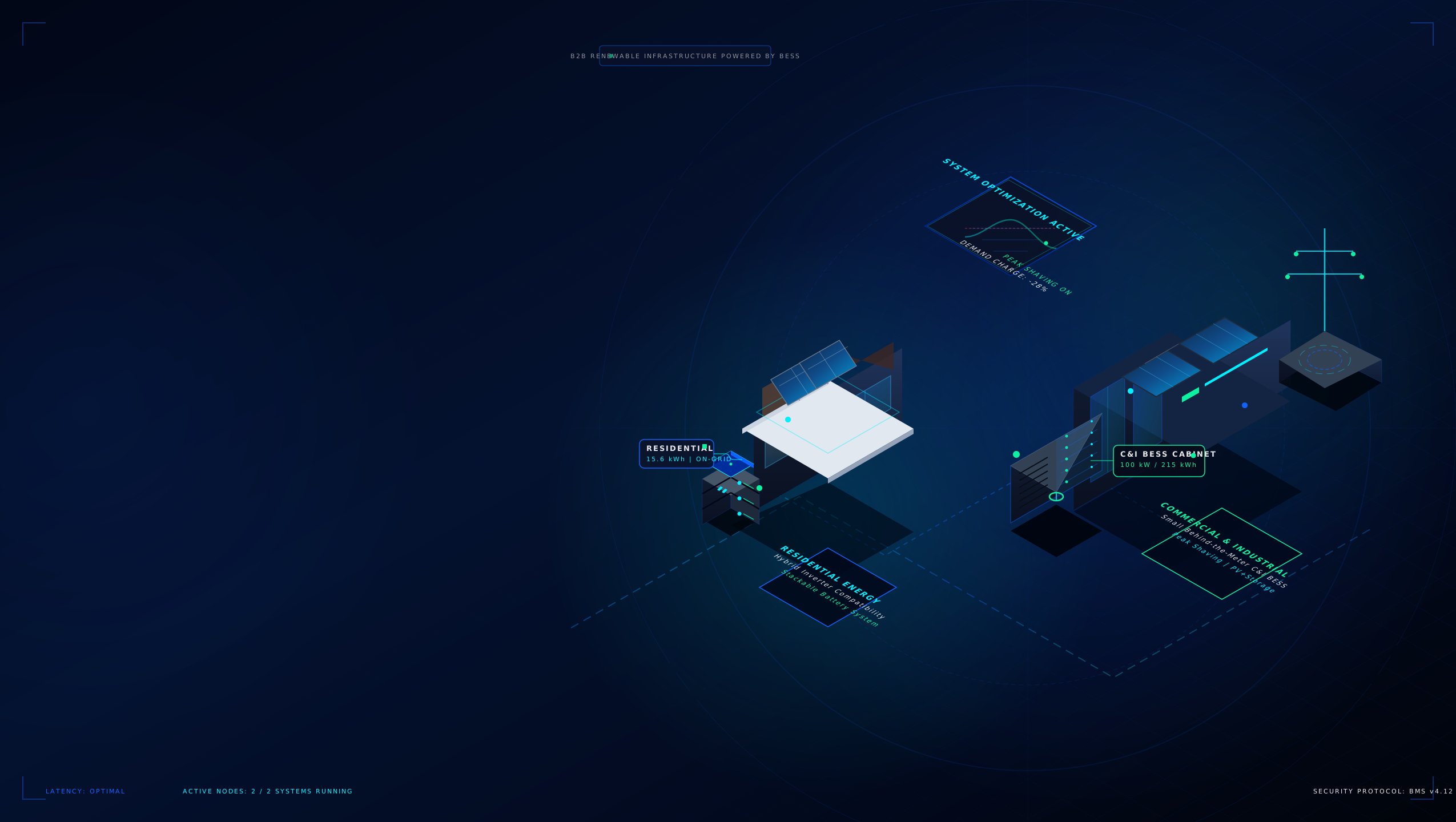
Commercial building with solar panels and integrated battery energy storage cabinets in Poland during a sunny morning.

Poland Energy Market Guide

Net Billing Poland: How the Prosumer Settlement System Works for Solar & Battery Storage

A practical guide to Poland's net billing system: how prosumer deposits, RCE/RCEm pricing, and self-consumption shape real solar and storage savings.

What Is Net Billing in Poland?

A market-based settlement model for solar prosumers that replaced Poland's earlier energy-discount scheme.


Defining the Photovoltaic Billing System Poland Uses Today

Net billing is the mandatory settlement mechanism for rooftop solar connected in Poland after April 1, 2022. Instead of storing surplus kilowatt-hours in the grid, the photovoltaic billing system Poland operators use converts exported energy into money at market rates. For prosumers, production timing, consumption, and battery capacity now shape the final bill, not just total generation.
 

From Feed-in Tariff to Market-Based Settlement

Before 2022, prosumers relied on a fixed discount ratio. Today's feed-in tariff Poland solar owners receive tracks the wholesale market instead. As a LiFePO4 manufacturer, Rakour designs its RAKOURHV and RAKOURLV storage systems to help households capture value here, rather than exporting cheap surplus for costlier repurchase later.

How Does Net Billing Work in Poland?

The settlement cycle explained, from grid export to deposit credit and final invoice.

Hourly Settlement Under the RCE Rate

Since July 2024, exported energy can be valued using the RCE energy price Poland publishes hourly, based on day-ahead trading. Midday surplus, when supply is high, is often priced lower than energy purchased in the evening. Rakour's rackable LiFePO4 systems, built with fast-response BMS units, help households shift stored energy into these higher-value evening hours.


Monthly Settlement Under the RCEm Rate

Prosumers connected earlier may instead use the RCEm monthly energy price, an averaged monthly rate. Either way, the resulting value is credited to a virtual account one month later, not instantly, which is why storing energy on-site with a Rakour LiFePO4 system often outperforms exporting it for delayed credit.

Net Billing vs Net Metering in Poland

Comparing the current market-value system with the earlier quantity-based discount model.


Quantity-Based vs Value-Based Settlement Rules

The old system exchanged energy 1:0.8 or 1:0.7 by volume. Current net billing settlement rules instead convert every exported kilowatt-hour into money at market price, then use that balance to offset future purchases. This shift rewards installations sized to actual demand, a principle Rakour follows when specifying battery capacity for its LV and HV lines.


Who Can Still Use the Old Discount System

Only installations connected before April 1, 2022 may keep net metering, for up to fifteen years from first export. Later systems, and anyone voluntarily switching, remain permanently under the value-based framework, making storage sizing decisions effectively irreversible for most new solar and battery buyers.

Understanding the Prosumer Deposit System

How exported solar value accumulates, expires, and gets refunded under Polish regulations.


How the Prosumer Deposit Poland Account Works

Every exported kilowatt-hour's market value lands in a virtual account known as the prosumer deposit Poland utilities maintain per household. Credited one month after export, this balance offsets only active energy charges, not distribution fees or standing charges, which is why maximizing self-consumption still matters even with a well-sized Rakour battery installed.


The 12-Month Usage Window and Refund Limits

Deposit funds must be used within twelve months of being credited, or they partially expire and lose most of their value. Unused balances refund at only 20 to 30 percent, depending on the pricing option chosen. A correction factor of 1.23 has applied since 2025, modestly boosting deposit value for storage-supported households.

Net Billing Regulations and Recent Policy Updates in Poland

A timeline of the legal changes shaping how solar prosumers are settled today.


The 2022 RES Act and the Start of Net Billing

The current system began under the Poland RES Act net billing provisions effective April 1, 2022, replacing the earlier discount scheme with market-priced value credited to each prosumer's account.


The 2024 Shift to Hourly RCE Pricing

From July 2024, regulators added hourly RCE pricing alongside the existing monthly RCEm rate. Rakour tracks these shifts closely, since hourly volatility makes battery-backed self-consumption the more reliable savings strategy for most households.


The 2025 Correction Factor Amendment

A December 2024 amendment introduced a 1.23 correction factor from January 2025 onward, modestly raising deposit value. Each revision changes the payback math for solar or storage investments planned around Poland's prosumer framework.

Key Factors That Determine Net Billing Profitability

The practical variables that decide whether a solar and storage investment pays off.


Maximizing Self-Consumption Photovoltaic Poland Households Need

The self-consumption photovoltaic Poland households achieve directly determines savings, since on-site use avoids export and repurchase prices alike. A Rakour LiFePO4 battery raises this ratio, storing midday surplus for evening use.


Right-Sizing Your PV and Battery System

Oversizing to chase summer production no longer pays off, since surplus sells at low rates. Matching PV output and Rakour battery capacity to real annual consumption, typically 100 to 110 percent of demand, produces steadier returns.


Shifting Load to Peak Production Hours

Running washing machines, dishwashers, or EV charging during midday hours further reduces reliance on the deposit. Paired with a properly sized Rakour system, this habit shift often delivers larger savings than resizing the installation alone.

The Role of Energy Storage Under Net Billing

Why pairing solar with a battery system changes the underlying investment math.


Why Energy Storage Net Billing Poland Systems Complement Solar

An energy storage net billing Poland installation addresses the model's core weakness: exported energy is often priced below what it costs to repurchase later, a gap on-site storage removes almost entirely.


Battery Storage Solar Savings With Rakour LiFePO4 Systems

Rakour's RAKOURLV and RAKOURHV batteries pair CE and UN38.3 certified LiFePO4 cells with a built-in BMS, delivering battery storage solar savings through cycle life ratings up to 11,000 cycles.


Choosing Between RAKOURLV and RAKOURHV for Your Home

RAKOURLV modules suit single-family homes needing up to 15 units in parallel, while RAKOURHV cabinets scale for larger sites. Both work with Deye inverters and carry a 5-year warranty.

Common Net Billing Myths, Clarified

Separating regulatory fact from widespread prosumer misconceptions.


Is Net Billing Really Less Profitable?

Many assume net billing made solar unprofitable, but rising retail prices have largely offset lower export values. With disciplined self-consumption and a correctly sized Rakour battery, households still cut electricity bills by 60 to 90 percent.


Does a Longer Billing Period Help?

Under net metering, longer periods once let surplus cover deficits months later. Net billing removed that advantage, since deposits credit only the following month. Monthly invoicing now helps prosumers catch production problems early instead.


Will Oversizing Your System Pay Off?

Building the largest possible installation no longer guarantees the best return, since surplus sells at low rates and unused deposits eventually expire. A right-sized Rakour PV and battery pairing consistently outperforms oversized systems chasing peak output.

Net Billing Poland FAQs

Quick answers to the most common questions about Poland's solar prosumer settlement system.

What is the prosumer deposit Poland uses to credit exported solar energy?

The prosumer deposit Poland maintains is a virtual account that stores the market value of exported solar energy, credited one month after export and used to offset future active energy charges only.

How does the RCE energy price Poland publishes affect my bill?

The RCE energy price Poland publishes hourly sets the value of energy you export at that exact hour, so exporting at midday, when prices are low, earns far less than evening or winter export. 

What is the RCEm monthly energy price and who still uses it?

The RCEm monthly energy price averages exported energy value across an entire month rather than by the hour, and remains available to prosumers who connected their installation before mid-2024.

Why does self-consumption photovoltaic Poland households achieve matter?

Self-consumption avoids the low export price and the higher retail price at once, so raising this ratio, often with battery storage, delivers the largest and most reliable bill savings for households.

How does energy storage net billing Poland systems improve savings?

Energy storage lets households keep surplus solar power on-site instead of exporting it for a low, delayed deposit credit, using it later at full retail value and cutting reliance on market pricing. 

Ready to Optimize Your Net Billing Savings?

Ready to Optimize Your Net Billing Savings?

Talk to Rakour's team about sizing a LiFePO4 battery system built for Poland's net billing rules.