
Rakour
Menu
High Voltage Home Battery Storage System for Residential & Commercial Use

High Voltage Energy Storage Solutions

High Voltage Home Battery Storage System for Residential & Commercial Use

Scalable LFP battery systems from 5 kWh to 160+ kWh. Built-in BMS, Wi-Fi monitoring, and broad inverter compatibility for reliable energy independence.

What Is a High Voltage Battery Energy Storage System?

Understanding how HV systems differ from standard 48V setups — and why it matters for your energy project.

Efficiency schematic comparing High Voltage 400V thin cables and Low Voltage 48V thick copper cables copper loss.

What Does "High Voltage" Mean in Battery Storage?

A high voltage battery system operates above 100V DC, typically between 200V and 980V. Unlike standard 48V low-voltage systems, HV architecture reduces current flow for the same power output, meaning thinner cables, lower transmission losses, and greater overall efficiency. Rakour's HV series operates within a working voltage range of 232V–979.2V.
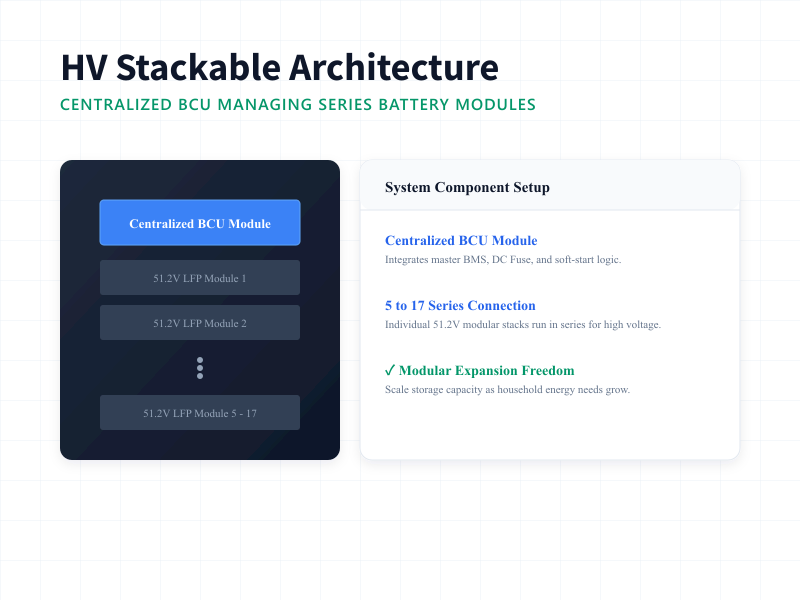
Structural layout of a stackable high-voltage battery system showing series module connection and centralized BCU.

How the HV Battery System Is Structured

Each Rakour home battery storage system consists of 5 to 17 individual 51.2V LiFePO4 modules connected in series, managed by a centralized BCU (Battery Control Unit). The BCU integrates the master BMS, DC fuse, soft-start circuit, and power management logic into a single controlled unit.

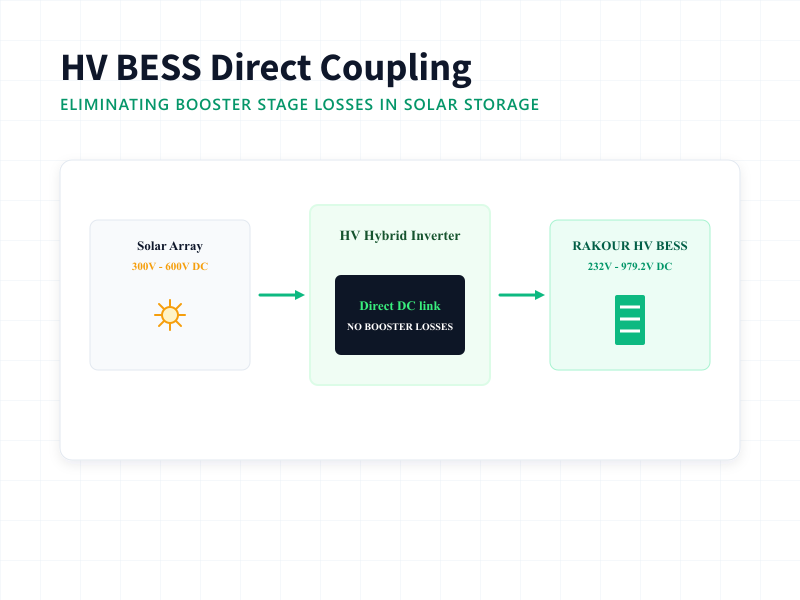
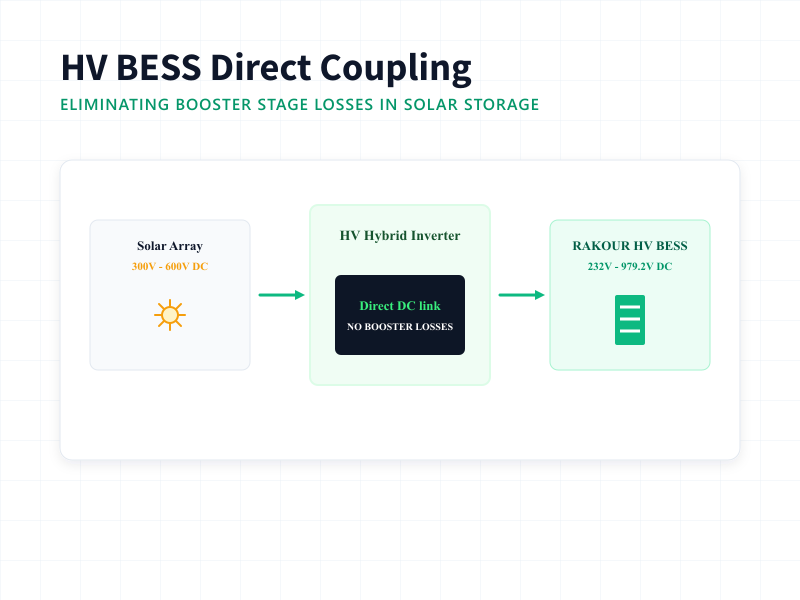
Direct DC coupling topology of high-voltage BESS showing connection with high-voltage solar hybrid inverter.

What Is BESS and Where Does HV Fit?

A battery energy storage system (BESS) is any setup that stores electrical energy for later use. HV-based BESS platforms are increasingly adopted in residential, commercial, and light industrial projects because they pair directly with high-voltage inverters — eliminating the step-up conversion losses common in lower-voltage designs.

High Voltage Battery vs. Low Voltage Battery: Which System Fits Your Needs?

A straightforward comparison of HV and LV battery storage to help installers and buyers choose the right architecture for their project.

Key Technical Differences

High voltage battery systems operate between 200V–980V, while low-voltage systems are fixed at 48V. HV systems carry less current for equivalent power — a 10 kW HV system at 500V draws only 20A versus 208A at 48V. Lower current means thinner wiring, reduced heat, and higher round-trip efficiency on larger installations.

Which Scenarios Suit Each System?

LV systems work well for small residential setups under 15 kWh with standard 48V inverters. Rakour's home battery storage system in HV configuration is better suited for whole-home backup, commercial demand management, and solar-plus-storage projects above 20 kWh — where efficiency gains and inverter compatibility justify the architecture choice.

Why Lifepo4 vs Lithium Ion Chemistry Matters Here

Both HV and LV systems can use LiFePO4 or NMC cells. However, lifepo4 vs lithium ion comparisons consistently show LFP offers superior thermal stability at high-voltage series configurations — a critical advantage. Rakour exclusively uses LiFePO4 cells across all HV product lines for this reason.

How a Rakour Battery Energy Storage System Works — From Cell to Load

A clear breakdown of the energy flow and control logic inside Rakour's HV battery storage systems, designed for installers and technical buyers.

Energy flow diagram illustrating AC-to-DC charging and DC-to-AC discharging path through high-voltage battery BCU.

Energy Flow: Charging and Discharging

During charging, AC power from the grid or PV inverter is converted to DC and stored across the series-connected 51.2V modules. The BCU governs charging voltage and current limits in real time. During discharge, stored DC energy flows through the BCU to the inverter, which converts it back to AC for home or commercial loads.

Dual-layer BMS architecture chart showing centralized Master BMS in BCU and Slave BMS inside series battery modules.

The Role of the Battery Management System

Rakour's dual-layer battery management system includes a master BMS inside the BCU and a slave BMS in every individual module. The BMS battery management system monitors cell voltage, current, and temperature continuously — triggering protection responses for overcharge, over-discharge, over-current, and thermal anomalies without manual intervention.

Communication circuit diagram showing CAN/RS485 link and soft-start protection system between inverter and HV battery.

How Does the Inverter Work with the HV Battery?

The HV battery communicates with the inverter via CAN or RS485 protocol. The bms battery management system transmits real-time state-of-charge and fault data directly to the inverter. Rakour's built-in soft-start circuit also protects inverters that lack native soft-start functions, ensuring a safe and stable connection at system startup.

Rakour HV Battery Capacity, Voltage Range, and Core Specifications Explained

Real numbers from Rakour's HV datasheets — so you can evaluate system suitability before requesting a quote.

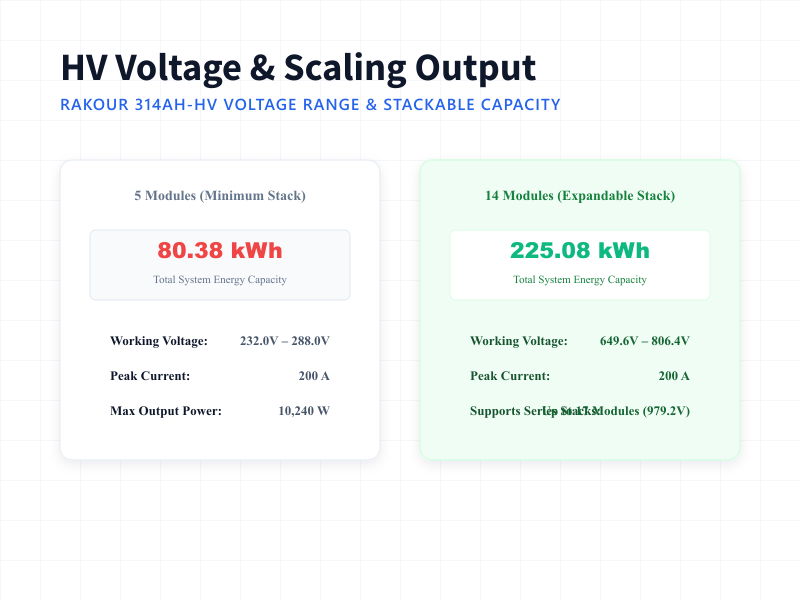
Technical comparison chart of Rakour 314Ah-HV system scaling from 5 modules (80kWh) to 14 modules (225kWh).

Understanding Voltage Range and Power Output

Rakour's 51.2V314Ah-HV supports 5 to 17 modules in series, giving a working voltage range of 232V to 979.2V. Total energy scales from 80.38 kWh (5 modules) to 225.08 kWh (14 modules). Maximum current is 200A with a peak power of 10,240W per module count — making it viable for demanding residential and light commercial loads.

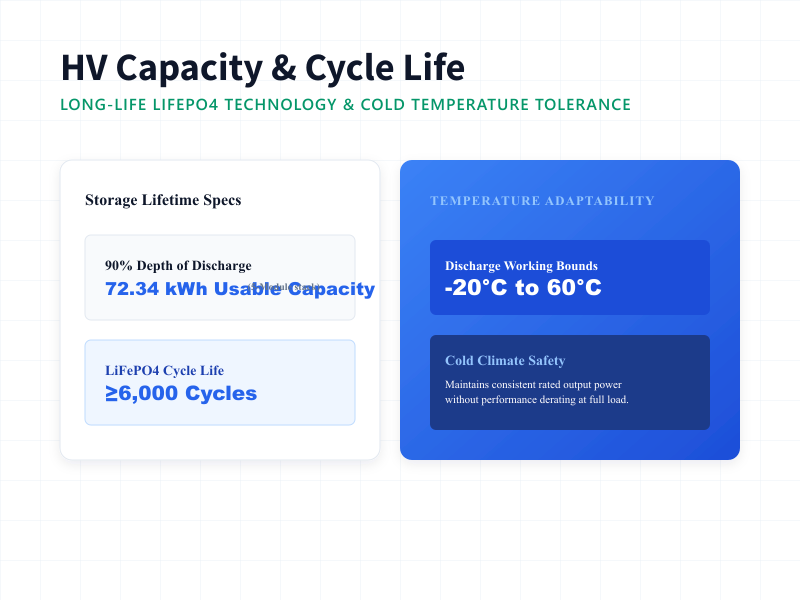
Lifespan and temperature tolerance specs of 314Ah-HV battery showing 6000 cycles and -20C cold climate operation.

Battery Capacity and Cycle Life

Usable battery capacity at 90% depth of discharge starts at 72.34 kWh for a 5-module system. LiFePO4 battery life exceeds 6,000 charge-discharge cycles under standard conditions. Rakour's HV modules operate across a discharge temperature range of −20°C to 60°C, maintaining consistent output in cold climates without performance derating at rated load.

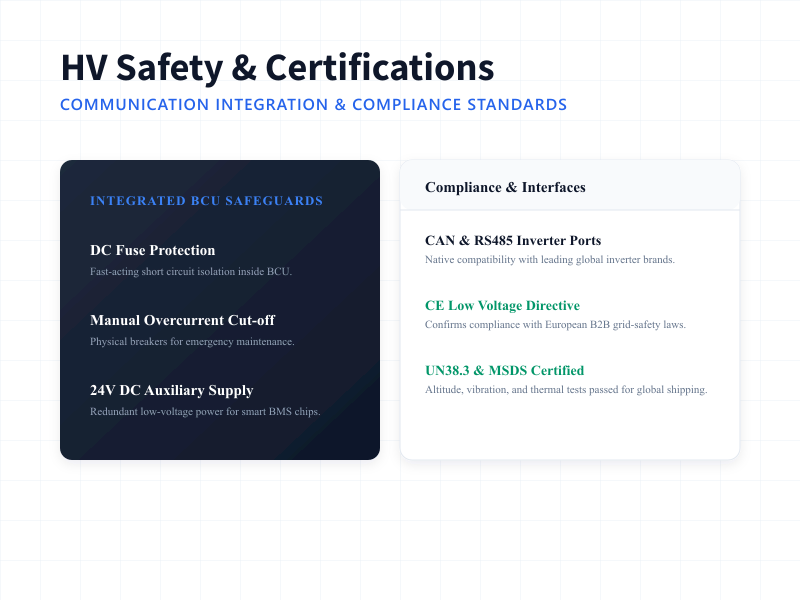
Protection mechanisms and CE UN38.3 certification badges of Rakour 314Ah high-voltage battery system.

Communication, Protection, and Certifications

All Rakour HV systems support CAN and RS485 communication protocols for inverter integration. The BCU includes a DC fuse, cut-off protection switch, and 24V DC power supply module. Current certifications cover CE, MSDS, and UN38.3, confirming compliance with international transport and electrical safety standards relevant to residential and commercial deployments.

Residential Energy Storage, C&I, and Beyond — Where Rakour HV Systems Deliver

From whole-home backup to commercial peak shaving, here are the real-world scenarios where Rakour's high voltage systems perform best.

Residential: Whole-Home Backup and Solar Self-Consumption

For large residential properties, Rakour's home battery storage system provides seamless backup across all circuits — including HVAC, EV charging, and kitchen appliances. Paired with rooftop PV, the HV system prioritizes solar energy storage during daylight hours and discharges during peak-rate evening windows, reducing grid dependency and utility costs.

Explore Industrial and Commercial Backup Power Solutions

Commercial: Demand Charge Management and Peak Shaving

In commercial battery storage applications — factories, warehouses, retail facilities — Rakour HV systems absorb energy during off-peak hours and discharge during demand peaks. This directly reduces demand charges on commercial utility bills. Systems support TOU (time-of-use) scheduling, allowing operators to pre-program charge and discharge windows around their tariff structure.

Explore Optical Storage Integrated Solution

Microgrids and Energy Storage in Off-Grid Settings

Microgrids and energy storage are increasingly deployed in remote facilities, agricultural operations, and island communities. Rakour HV batteries support both on-grid and off-grid operation. Up to 4 sets can be connected in parallel, enabling multi-hundred-kWh microgrid configurations that pair with diesel generators or wind-solar hybrid generation for continuous, reliable power.

Explore Industrial And Factory Energy Storage Solution

Modular by Design — How Rakour Storage Battery Systems Scale with Your Project

Whether you need 80 kWh today or 225 kWh next year, Rakour's HV architecture lets you add capacity without replacing what's already installed.

Modular high-voltage energy storage battery stack showing incremental capacity expansion up to 17 modules.

Starting Small, Growing on Demand

Rakour's HV series begins at 5 battery modules per string — delivering 80.38 kWh of total energy. Each additional 51.2V module added in series increases capacity incrementally. The 51.2V314Ah-HV supports up to 17 modules in a single string, reaching 225.08 kWh. This modular design means projects can start within budget and expand as load requirements increase over time.

Parallel multi-string wiring connection layout for high-voltage commercial BESS scaling up to 900kWh.

Parallel Strings for Larger Projects

For projects exceeding a single string's output, Rakour HV systems support up to 4 sets connected in parallel. This enables multi-string configurations exceeding 900 kWh in total capacity. Each parallel set maintains independent BCU management, ensuring balanced charge and discharge across all strings without cross-interference or capacity degradation between units.

Physical stackable rack and battery cabinet setup showing 300mm ventilation clearance requirements.

Physical Installation Flexibility

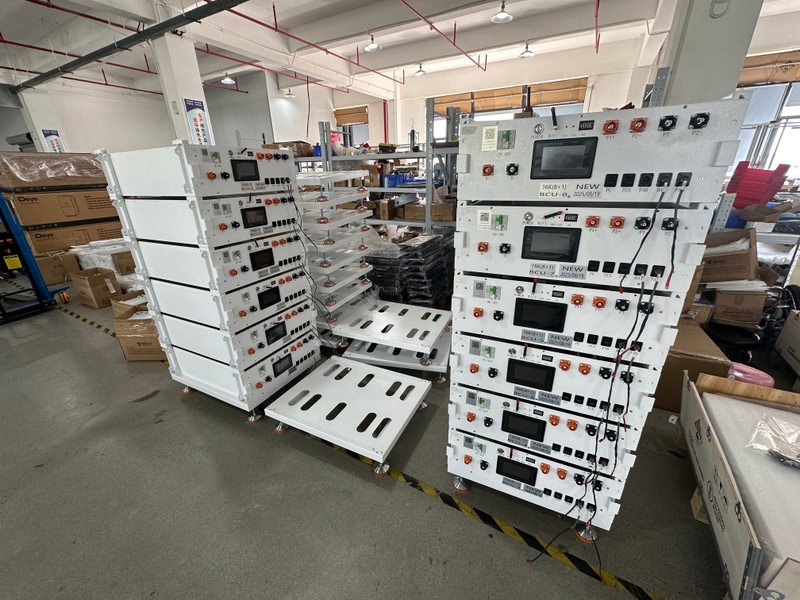
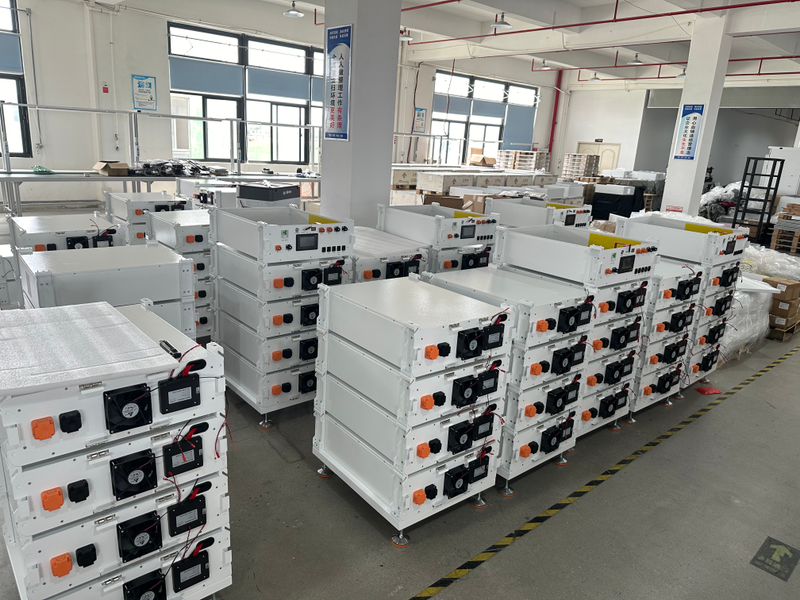
Rakour HV modules mount using stackable sheet metal frames or a dedicated battery cabinet — both orderable through Rakour's distribution network. Modules stack vertically with a minimum 300 mm clearance around each unit for ventilation. The rack-and-frame system requires no special flooring and fits standard indoor mechanical rooms, reducing civil construction costs for commercial and residential installations.

Why Rakour Uses Lithium Iron Phosphate Cells in Every HV System

The chemistry choice behind every Rakour HV battery — and why it matters for long-term safety, cycle life, and total cost of ownership.

What Makes Lithium Iron Phosphate Different

Lithium iron phosphate (LFP) cells use an iron-phosphate cathode rather than nickel or cobalt compounds. This structural difference eliminates the oxygen-release mechanism responsible for thermal runaway in NMC and NCA chemistries. LFP cells remain chemically stable even under overcharge, short circuit, or mechanical stress — making them the correct choice for high-voltage series configurations where cell-level failures can cascade rapidly.

Cycle Life Advantage: Real Numbers from Rakour Products

Rakour's 51.2V314Ah-HV achieves ≥8,000 charge-discharge cycles. The 51.2V280Ah-LV reaches ≥10,000 cycles, and the 314Ah-LV variant exceeds ≥11,000 cycles. At one cycle per day, the higher-tier models represent over 27 years of daily operation. This directly reduces replacement frequency, lowers lifetime cost per kWh delivered, and supports bankability for commercial energy storage projects requiring long warranty coverage.

Operating Temperature and No Memory Effect

Rakour LFP modules discharge from −20°C to 60°C — ensuring reliable performance in cold climates without thermal derating. LFP chemistry carries no memory effect, meaning cells can be charged and discharged at any state-of-charge without capacity loss from partial cycling. This flexibility suits time-of-use optimization strategies where charge depth varies daily based on grid tariff windows.

Built-In Protection and Verified Safety — Rakour's Lithium Ion Battery Safety Architecture

A breakdown of the hardware protections, installation safeguards, and international certifications built into every Rakour HV battery system.

Multi-Layer BMS Protection Mechanisms

Every Rakour HV system runs a dual-layer protection structure. The slave BMS inside each 51.2V module monitors individual cell voltage and temperature in real time. The master BMS within the BCU consolidates this data and enforces system-level responses — triggering automatic cutoff for overcharge, over-discharge, over-current, and both high and low temperature fault conditions before damage occurs.

Hardware Safety Components in the BCU

Beyond software protection, Rakour's BCU integrates a DC fuse, a hard cut-off protection switch, and a soft-start circuit. The soft-start circuit limits inrush current at system startup — a critical feature for lithium iron phosphate fire hazards prevention in high-voltage configurations. The mounting carrier must be fire-resistant per installation guidelines, and all systems require proper grounding to prevent electric shock risk during operation or fault events.

International Certifications Covering All Rakour HV Products

All Rakour HV batteries carry CE marking and UN38.3 certification — required for international transport and electrical safety compliance. Select models additionally hold IEC62619 certification, the globally recognized standard for secondary lithium ion battery safety in stationary energy storage applications. These certifications are verified by independent third-party testing bodies, providing installers and end-users with documented evidence of product compliance before deployment.

Battery Inverter Compatibility — How Rakour HV Systems Connect to Your Inverter

Practical wiring, communication protocol, and inverter pairing information for installers configuring Rakour HV batteries in the field.

Supported Communication Protocols

Rakour HV batteries communicate with inverters via CAN or RS485 protocol through a standard RJ45 port on the BCU. The BMS transmits real-time state-of-charge, voltage, current, and fault status directly to the inverter's BMS input port. The inverter then adjusts charging voltage, charging current, and discharge cut-off thresholds dynamically based on the data received — enabling fully automatic, self-managing operation without manual parameter intervention.

Confirmed Compatible Inverter: Deye Series

Rakour provides documented integration guides for Deye inverter models including the SUN-29.9K to SUN-80K-SG02HP3 series. For the 80K series, the BCU's P1+ and P2+ dual-output ports connect to the inverter's BAT1 and BAT2 input ports simultaneously — a parallel shunting configuration that increases effective discharge power while keeping current within each port's 50A limit, reducing system cost without additional hardware.

Soft-Start Support and Third-Party Compatibility

Rakour's built-in soft-start circuit inside the BCU allows the battery inverter to connect without requiring a native soft-start function on the inverter side. This broadens compatibility across multiple inverter brands beyond Deye. Communication settings are configured via the BCU touch screen or RS232 upper computer port, where installers can read and modify BMS parameters directly to match third-party inverter requirements for voltage range and protocol selection.

Real-Time Control with Rakour's Built-In Battery Monitoring System

How Rakour's HV systems keep operators informed and in control — from the local touch screen to smartphone remote access.

Touch Screen Interface and Local Status Monitoring

Every Rakour HV BCU includes an external color touch screen that displays total system voltage, state-of-charge (SOC), current, and individual cell voltage highs and lows in real time. Operators can switch between day and night display modes, adjust screen brightness, and access engineering mode for detailed per-cell diagnostics — all without connecting a laptop or external device. Fault events are flagged directly on the home screen with alarm notifications.

Wi-Fi Remote Monitoring and Parameter Management

Rakour's built-in Wi-Fi module connects to the PACEex monitoring app, available for smartphone. After Wi-Fi binding, operators can remotely view SOC, cell voltage balance, temperature readings, and cumulative charge and discharge capacity from any location. The battery monitoring system also supports remote parameter modification and OTA firmware upgrades — eliminating the need for on-site visits to adjust protection thresholds or update system configuration after initial commissioning.

Bluetooth and PC Upper Computer Access

For on-site commissioning without Wi-Fi infrastructure, Rakour systems also support Bluetooth local control through the same PACEex app. Additionally, the RS232 upper computer port allows direct PC connection via USB-CAN cable — enabling advanced parameter reading, BMS address configuration, and full diagnostic data export for installers managing multiple sites or documenting system performance for project commissioning records.

Frequently Asked Questions About Rakour High Voltage Battery Storage Systems

Real answers to the questions installers and buyers ask most about Rakour HV battery systems.

What is the maximum capacity of a single Rakour HV battery energy storage system?

A single 51.2V314Ah-HV string supports up to 17 modules in series, totaling 225.08 kWh. Up to 4 strings connect in parallel for 900+ kWh combined. Each string has its own BCU.

Which battery inverters are compatible with Rakour HV battery systems?

Rakour HV batteries work with Deye SUN-29.9K to SUN-80K inverters via CAN or RS485. The built-in soft-start circuit supports inverters without native soft-start, broadening compatibility.

How does the battery management system protect a high voltage battery during operation?

Rakour's dual-layer BMS monitors each cell via slave BMS and enforces system-level cutoff through the master BMS in the BCU — covering overcharge, over-discharge, over-current, and temperature faults.

What certifications do Rakour HV lithium iron phosphate battery systems carry?

All Rakour HV batteries carry CE and UN38.3 certification. Select models also hold IEC62619, the international standard for stationary lithium-ion battery safety, verified by independent testing bodies.

Can I monitor and manage a Rakour home battery storage system remotely?

Yes. Rakour's built-in Wi-Fi connects to the PACEex app for remote SOC monitoring, cell voltage, temperature readings, parameter changes, and OTA firmware upgrades — all without requiring an on-site visit.

Get a Custom HV Battery Storage Solution Quote from Rakour Today

Get a Custom HV Battery Storage Solution Quote from Rakour Today

Share your project needs and get a tailored Rakour HV battery system configuration within 24 hours.